
The story of Southwestern jewelry doesn't begin with silver. It’s far older than that, a story told in stone, shell, and bone. For thousands of years, the indigenous peoples of the Southwest crafted adornments that were deeply tied to the land, their spirituality, and their very identity. This ancient tradition is the bedrock upon which the iconic silver and turquoise styles we know today were built, forming the foundation of modern Southwestern and estuarian cowgirl jewelry.
Crafting Identity from Earth and Spirit
Think of jewelry as a language spoken long before written words. That’s the heart of early Southwestern adornment. For millennia, tribes transformed materials pulled directly from the earth into powerful statements of personal and cultural importance. This wasn't just decoration; it was a wearable story, a tangible link to the spirit world and the natural environment.
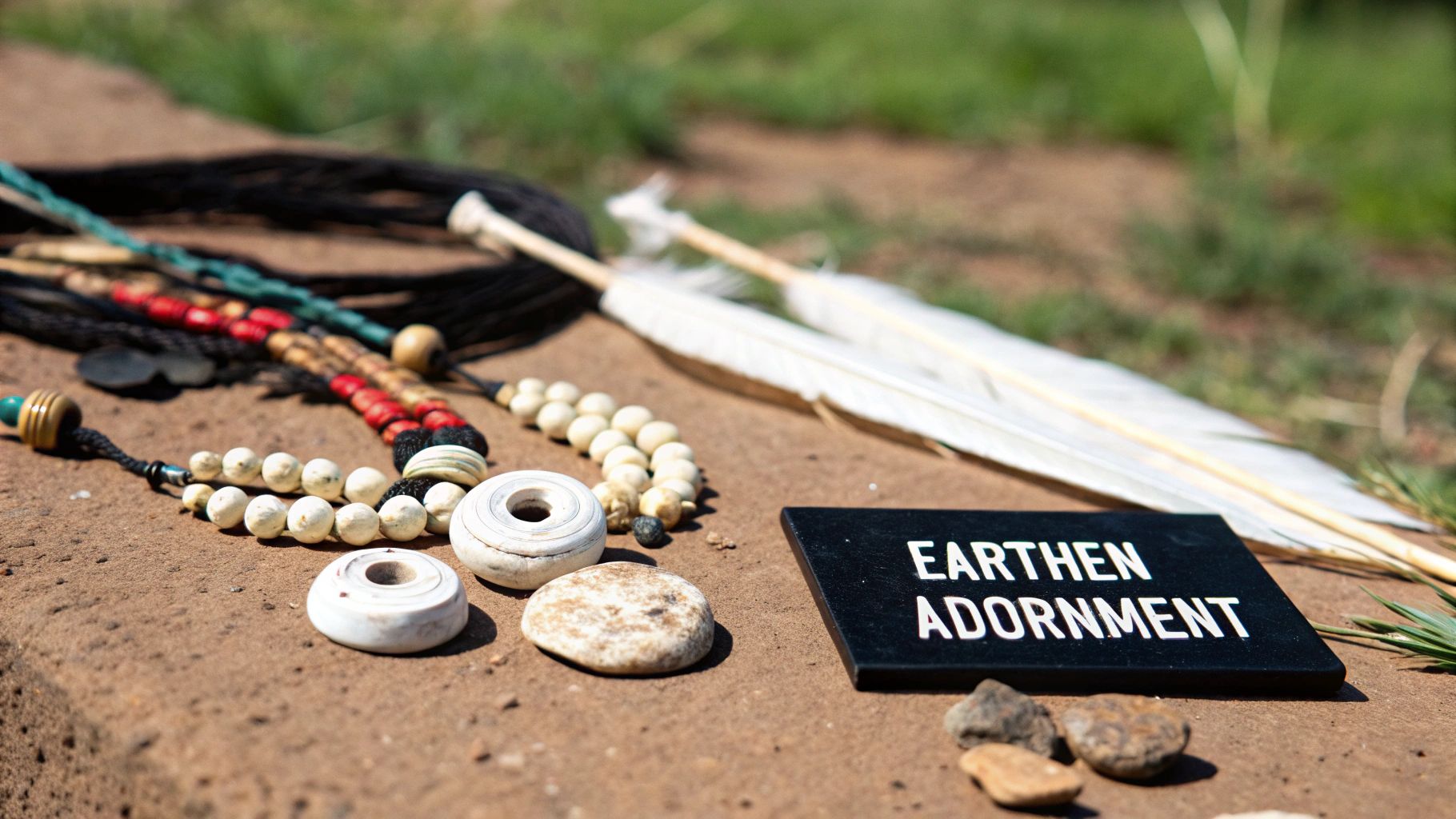
The earliest pieces are a testament to incredible ingenuity. Artisans painstakingly worked with materials that held both practical and sacred meaning. The act of creating these items was just as meaningful as the finished piece itself, embedding each one with purpose and power.
The Original Materials of Adornment
Before metalworking found its way to the Southwest, a rich palette of natural elements formed the foundation of all jewelry. Every material was chosen for its beauty, its strength, and its symbolic weight.
- Shells: Sourced through ancient trade routes that stretched all the way to the coasts, shells like abalone and olivella were treasured for their iridescent shimmer. They were often carved into intricate beads and pendants.
- Stones: Turquoise, the "sky stone," was already highly valued for its striking color and spiritual importance. Other local stones like jet, argillite, and various quartzes were also central to their work.
- Bones and Antlers: These materials were carefully shaped into beads, pendants, and hairpins, honoring the animals they came from and carrying the symbol of their strength.
- Seeds and Wood: Juniper seeds, porcupine quills, and different local woods were used to create organic, textured pieces that were a direct reflection of the immediate landscape.
This tradition of adornment is incredibly deep. In fact, evidence suggests that Native American jewelry traditions go back at least 10,000 years to the Paleo-Indians, the earliest people of the Americas.
These first creations, crafted from whatever the local environment provided, communicated everything from tribal identity and spiritual beliefs to social standing.
More Than Just Decoration
In these early cultures, jewelry was never just for show. It served crucial functions, acting as a visual marker of one's place in the world. A particular necklace could signify a person's clan, their marital status, or their accomplishments as a hunter or a healer.
These pieces were also central to spiritual life. Adornments were worn in ceremonies to call for protection, to honor deities, or to open a connection with the spirit world. They were often included as grave offerings, accompanying the deceased on their journey into the afterlife.
This profound legacy—where jewelry is inseparable from identity, spirituality, and community—set the cultural stage for everything that would follow. The immense value placed on beautiful, meaningful adornment created a readiness for new materials and techniques. The scene was set for a dramatic evolution, one that would eventually introduce metal and forever change the face of Southwestern style. It's fascinating to explore how jewelry connects heritage with modern elegance even today.
The Arrival of Silver and a New Artistic Dawn
For thousands of years, the story of Southwestern jewelry was written in shell, stone, and bone. But in the mid-1800s, a new material arrived that would change everything: silver. This wasn't a case of one tradition replacing another, but rather a powerful fusion that sparked an incredible surge of creativity, forever shaping the art form.
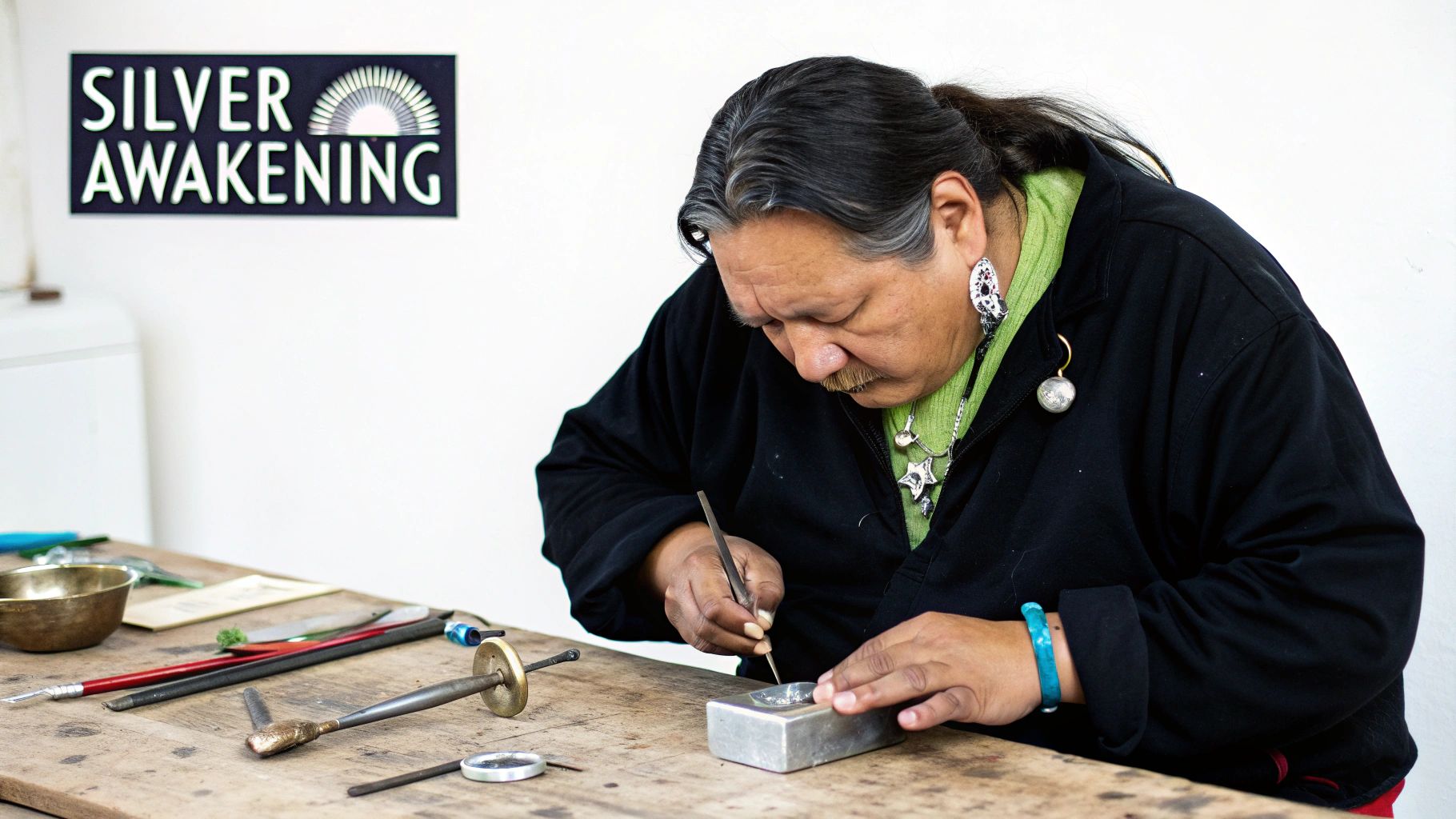
This wasn't about imitation; it was about brilliant adaptation. Native artisans saw the decorated metal bridles of the Spanish and the intricate silverwork of Mexican plateros (silversmiths) and recognized a world of possibility. They found a gleaming new canvas to express their deeply ingrained design philosophies—a radiant medium for the symbols that already held profound cultural meaning.
The Navajo Embrace of Silversmithing
The Navajo (Diné) are widely recognized as the first Southwestern tribe to truly master silversmithing. After learning the basics from Mexican smiths, they quickly absorbed the craft and began infusing it with a uniquely Navajo point of view.
One of the most celebrated early smiths was a man named Atsidi Sani, or "Old Smith." In the late 1800s, he started melting down silver coins and scrap metal, hammering them into the first pieces of wearable art that would become the foundation for the entire tradition of history of Native American jewelry. His work, and that of others from his time, set the stage for a lasting artistic legacy.
At its core, this artistic movement was about fusion. It combined ancient design principles—a reverence for balance, nature, and symbolism—with the brand-new possibilities offered by a durable, radiant metal. Silver became a new voice for an old story.
The metal itself, often painstakingly sourced from American and Mexican coins, was a precious resource. This made the jewelry incredibly valuable, acting not just as beautiful adornment but also as a form of portable wealth and a clear symbol of status.
A Skill Shared Across Cultures
Word of this powerful new art form traveled fast. Silversmithing knowledge spread organically through trade and relationships, sending a creative ripple effect across the Southwest.
The timeline shows just how quickly this shared innovation took hold. After the Navajo began mastering the craft in the mid-to-late 1800s, historical accounts show the knowledge spread with incredible speed between 1870 and 1890. Navajo smiths taught the Zuni around 1872, and the Zuni, in turn, passed their skills on to their Hopi neighbors by about 1890.
This inter-tribal sharing is a vital part of the story. It built a common technical vocabulary among the three major jewelry-making cultures of the region.
The Seeds of Distinctive Styles
Even with this shared foundation, each tribe immediately began to put its own spin on the craft. They were all speaking the new language of silver, but each developed its own distinct dialect.
- Navajo artisans focused on the silver itself, creating heavy, foundational pieces with bold stamp work and substantial, singular stone settings.
- Zuni artisans, who were already master stone cutters, used silver as a delicate framework to hold their intricate, multi-stone mosaics.
- Hopi smiths would later pioneer their unique overlay technique, using two sheets of silver to create stunning graphic designs with sharp, contrasting patterns.
This early period of learning, sharing, and innovation laid the groundwork for the diverse and beautiful styles we recognize today. The arrival of silver wasn't the end of an ancient tradition but the beginning of its most iconic chapter.
Turquoise: The Soul of Southwestern Jewelry
If silver gave Southwestern jewelry its iconic gleam, then turquoise gave it a soul. It's impossible to imagine one without the other. More than just a beautiful stone, turquoise is the spiritual and aesthetic heart of this art form—a vibrant splash of sky and water set against the warm tones of the desert.
Its arrival transformed silverwork from a craft into a cultural phenomenon, creating that quintessential look the world now recognizes as uniquely Southwestern.
The connection to this striking blue-green stone runs far deeper than its relatively recent pairing with silver. For millennia before the first piece of silver was ever hammered, turquoise was revered by the peoples of the Southwest. They didn't just see a pretty rock; they saw a sacred material, a fragment of the sky itself, believed to hold immense protective power and a connection to life-giving water.
An Ancient and Sacred Stone
You can trace the use of turquoise back through the long tapestry of the history of Native American jewelry. Archaeological finds confirm its importance stretching back thousands of years. In fact, evidence from the Hohokam culture in present-day Arizona shows turquoise artifacts dating to at least 200 B.C.
This long-standing reverence meant that when silver finally became available, turquoise was the natural—and most honored—choice to pair with it.
This marriage of silver and turquoise was more than just a smart design choice; it was a fusion of old and new worlds. The lustrous, modern feel of worked silver provided the perfect frame to showcase the ancient, earthy beauty of what they called the "sky stone." Together, they created a powerful visual language that was immediately recognizable and deeply meaningful.
Turquoise is not merely a component; it is a central character in the story of Southwestern art. It embodies a complex blend of spiritual significance, cultural identity, and natural beauty that is impossible to separate from the jewelry itself.
The stone was, and still is, often seen as a living entity. Its color can shift and deepen over time as it absorbs oils from the wearer's skin, a quality many believe reflects the health and spirit of the person wearing it. This makes each piece of turquoise jewelry a deeply personal talisman.
The Stone That Shaped a Region
The booming demand for turquoise, both within Native communities and from the growing tourist market, had a profound impact on the entire Southwest. It fueled extensive trade networks and kicked off mining operations across Arizona, New Mexico, Colorado, and Nevada.
Different mines began producing turquoise with their own unique personalities—from the deep, clear blue of Sleeping Beauty to the rich green laced with a golden spiderweb matrix from the Royston district.
This incredible variety pushed artists to innovate. They developed distinctive ways of cutting, shaping, and setting the stones to highlight the unique character of the turquoise from a particular mine.
- Cabochons: Smooth, domed cuts that let the stone's pure color and matrix patterns shine.
- Inlay: Precisely cut stones set perfectly flush against one another, creating intricate mosaics of color.
- Needlepoint and Petit Point: Tiny, meticulously hand-cut stones arranged in delicate, elaborate patterns—a true specialty of Zuni artists.
- Cluster Work: Artful arrangements of multiple stones, often surrounding a larger central gem, to create a bold, textured, and dramatic look.
These techniques weren't just about showing off technical skill; they were a direct conversation with the stone itself. Artists learned how to "read" a piece of rough turquoise, knowing instinctively the best way to cut it to reveal its inner beauty.
The enduring legacy of turquoise jewelry in our detailed guide is a testament to this deep connection between artist and material. Ultimately, the story of turquoise is the story of Southwestern jewelry itself—a vibrant, sacred, and timeless narrative of culture and art.
Defining Styles: The Artistic Signatures of Three Peoples
While the peoples of the Southwest shared foundational skills like silversmithing and a deep reverence for turquoise, that common ground became a launching point for breathtaking artistic diversity. The history of Native American jewelry isn't a single story but a collection of distinct voices. Learning to recognize the unique styles of the Navajo, Zuni, and Hopi is like learning to distinguish the dialects of a shared language—each has its own rhythm, vocabulary, and soul.
Instead of a dry checklist, think of it as appreciating three different master artists. One paints with bold, powerful strokes of silver. Another creates intricate mosaics with the patience of a watchmaker. And the third tells stories through striking graphic silhouettes. Each approach reveals a unique cultural perspective and a mastery of completely different techniques.
Navajo: The Power of Silver
Navajo (or Diné) jewelry is often defined by its reverence for silver. For Navajo smiths, the metal isn't just a frame for the stone; it is the main event. Their work feels substantial and foundational, characterized by heavy-gauge silver that has a satisfying weight and presence.
This silver-centric approach comes to life through a few signature techniques:
- Bold Stampwork: Navajo artists are masters of stamping, using handmade tools to create intricate patterns of crescents, sunbursts, and geometric lines that flow across the silver. This gives each piece a rich, textured feel.
- Substantial Stone Settings: When turquoise is used, it’s often a single, magnificent stone set in a simple bezel. This allows the gem's natural beauty to command all the attention, with the silver serving as a powerful throne.
- Iconic Forms: The Navajo are credited with creating some of the most recognizable forms in Southwestern jewelry, including the bold Naja pendant and the stately squash blossom necklace.
If Zuni jewelry is a quiet conversation among stones, Navajo jewelry is a bold declaration made by silver. Each piece feels like a powerful statement of strength, heritage, and connection to the earth.
Zuni: The Genius of Lapidary
Where Navajo artisans celebrate silver, the Zuni people express their genius through the stone itself. Zuni jewelry is a world of intricate, breathtaking precision. Their artists are unparalleled lapidarists, capable of cutting and setting tiny stones with a level of detail that is simply astounding.
The Zuni approach transforms jewelry into a delicate tapestry woven from stone and shell. Silver is present, but it often plays a supportive role, creating the delicate channels and bezels that hold the intricate lapidary work together.
This mastery is showcased in several distinct styles:
- Inlay: Stones are cut and fitted together so perfectly that they form a smooth, seamless surface of color, like a miniature mosaic. This includes channel inlay, where thin silver partitions separate each individual stone.
- Petit Point and Needlepoint: These styles involve cutting dozens—sometimes hundreds—of tiny, teardrop-shaped (petit point) or sliver-like (needlepoint) stones and setting them in elaborate, radiating patterns.
- Cluster Work: While also practiced by Navajo artists, Zuni cluster work is often more delicate and complex, featuring meticulously matched stones arranged in beautiful floral or sunburst designs.
To appreciate Zuni work is to appreciate patience and precision. Each piece is a testament to the artist's steady hand and incredible eye for detail. The infographic below shows just how central turquoise is to all these art forms, symbolizing everything from the sky and water to health and protection.

This really highlights how a single material can carry layers of meaning, influencing the art, spirituality, and economy of an entire region.
Hopi: The Art of Overlay
Hopi jewelry offers a completely different, yet equally compelling, artistic vision. Developed a bit later than the foundational Navajo and Zuni styles, the Hopi overlay technique is a masterclass in graphic design and storytelling. The process itself is a reflection of this precision.
Hopi artists begin with two identical sheets of sterling silver. They meticulously cut intricate designs—representing everything from clan symbols and water waves to animal figures—out of the top sheet. This top sheet is then perfectly soldered onto the solid bottom one.
But here's where the magic happens. The recessed areas of the bottom sheet are carefully oxidized, turning them a deep, matte black. The top sheet is then polished to a brilliant, mirror-like shine. The result is a stunning contrast between light and dark, creating designs that are crisp, clean, and profoundly symbolic.
This technique allows for a form of visual storytelling that is completely unique to the Hopi people, turning each cuff bracelet or pendant into a wearable narrative. Many of these pieces explore classic motifs, and you can delve deeper into western jewelry explained from turquoise to stamped silver in our comprehensive guide.
To help you tell these incredible styles apart, here’s a quick side-by-side look at what makes each one so special.
Distinctive Southwestern Jewelry Styles
| Tribe | Primary Technique | Common Aesthetic | Iconic Forms |
|---|---|---|---|
| Navajo | Silversmithing & Stamping | Heavy, substantial silver; bold, single stones; textured surfaces. | Squash Blossom Necklace, Concho Belts, Naja Pendants |
| Zuni | Lapidary (Inlay, Petit Point, Cluster) | Intricate, multi-stone mosaics; precise, delicate patterns; stone-dominant designs. | Inlay Bracelets, Cluster Rings, Needlepoint Earrings |
| Hopi | Overlay | Graphic, high-contrast silver; symbolic designs; clean, polished finish. | Overlay Cuff Bracelets, Bolos, Pendants |
Each of these traditions represents a distinct artistic legacy, a testament to the creativity and cultural richness of the people who developed them. Recognizing the differences isn't just about identifying jewelry; it's about appreciating the unique stories each piece has to tell.
Wearing History: Ethically Collecting Southwestern Jewelry
Connecting with the incredible history of Southwestern jewelry is about so much more than just appreciating its beauty. It’s about becoming a thoughtful, respectful collector. That means learning how to support the artists and communities that keep these vital traditions alive, ensuring your purchase is an act of genuine appreciation, not appropriation.
When you invest in an authentic piece, you aren't just buying an accessory. You're becoming a steward of a small piece of a much larger story, directly supporting an artist's livelihood and the continuation of their cultural legacy.
From Appreciation to Appropriation
The line between appreciating a culture and appropriating it can feel blurry, but it really hinges on one key concept: support. True appreciation involves learning about the art form, understanding its cultural context, and making sure your purchase financially benefits the Native artist who poured their skill and spirit into it.
Appropriation, on the other hand, is what happens when those styles are copied and mass-produced by non-Native companies, often overseas. This practice doesn't just mislead buyers; it actively diverts income away from Native artisans and devalues their authentic, handcrafted work.
The core of ethical collecting is ensuring that Native peoples remain in control of their own cultural narratives and artistic economies. Each authentic purchase is a vote for cultural sovereignty and artistic integrity.
How to Identify Authentic Jewelry
Verifying a piece's authenticity protects you as a collector and, more importantly, honors the artists themselves. The very first thing to look for is an artist's hallmark. This is a unique stamp or signature the artist uses to sign their work, just like a painter signing a canvas. While some very old, historic pieces might not have one, most contemporary artists proudly mark their jewelry.
Next, you'll want to train your eye to recognize the signs of genuine craftsmanship:
- Materials: Look for genuine sterling silver (often stamped ".925" or "Sterling") and natural stones. Real turquoise has beautiful, subtle variations in color and matrix (the host rock patterns) that imitation materials just can't replicate.
- Workmanship: Take a close look at the piece. Are the solder joints clean? Are the stones set securely? Does the design feel balanced and well-finished? The quality of the work speaks volumes about its origin.
Where to Buy Authentic Southwestern Jewelry
Where you buy your jewelry is just as important as what you buy. To make sure your money goes directly to supporting Native artists, it's crucial to seek out reputable sources.
- Reputable Galleries: Established galleries that specialize in Native American art are dedicated to representing artists fairly and accurately. They can give you detailed information about the artist, their tribal affiliation, and the story behind the piece.
- Juried Art Markets: Events like the Santa Fe Indian Market or the Heard Museum Guild Indian Fair & Market are incredible opportunities. You can meet artists in person, hear their stories firsthand, and buy directly from the source.
- Direct from Artists: Many artists now have their own websites or social media accounts where they sell their work. This offers the most direct connection possible to the creator behind the jewelry.
Learning to recognize the stories and symbols in these pieces deepens the connection immensely. For a closer look, you can learn more about Native American jewelry meanings in our guide. By choosing to buy ethically, you help ensure that the vibrant history of Native American jewelry continues to be written by the people who own it.
Your Questions About Southwestern Jewelry Answered
As you dive into the incredible world of Southwestern adornment, you're bound to have questions. The history is deep, the designs are intricate, and the cultural meaning runs through every piece. Think of this as your guide to some of the most common questions we hear, designed to give you clarity, confidence, and a much deeper appreciation for the art.
These answers go beyond the basics. They’re here to help you move from a casual admirer to a truly knowledgeable collector who understands this art form, its storied past, and how to engage with it respectfully.
What Is the Meaning of the Squash Blossom Necklace?
The squash blossom necklace is probably the most iconic design in Southwestern jewelry—you know it the second you see it. While its name connects it to the squash plant, a cornerstone of life and sustenance for Southwestern peoples, the shape itself tells a fascinating story of cultural exchange.
That striking crescent-shaped pendant at the bottom? That’s the "Naja." This symbol is actually thought to have Moorish origins, brought over by the Spanish who used it as a protective emblem on their horse bridles. The Navajo (Diné) saw this powerful shape, adopted it, and gave it new meaning as a symbol of protection, strength, and good fortune for whoever wears it.
And what about the smaller "blossoms" lining the sides of the necklace? They aren't a literal copy of the squash plant's flower. Instead, they're believed to be an artistic spin on the pomegranate flowers that were popular decorative elements in Spanish colonial silverwork. Over time, Navajo artists masterfully blended these outside influences into a design that is uniquely and powerfully their own.
Today, a squash blossom necklace stands as a bold symbol of prosperity, cultural identity, and the beautiful cycle of life.
How Can I Tell If Jewelry Is Authentic?
Knowing how to spot genuine, handcrafted jewelry versus a mass-produced imitation is the key to supporting Native artists. It really comes down to looking for a few tell-tale signs.
First, check for a hallmark or signature—this is the artist's personal stamp on their work. While many older pieces (think pre-1950s) are unsigned, most contemporary artists are proud to sign their creations. Next, take a close look at the materials.
- Sterling Silver: Real pieces are almost always made with sterling silver, which might be stamped with ".925" or "Sterling."
- Natural Turquoise: Authentic turquoise has natural variations in color and matrix (the web-like patterns of the host rock). If a stone looks perfectly uniform, almost like plastic, be cautious. It could be a sign of block turquoise or an imitation.
Craftsmanship is the ultimate giveaway. Look for clean solder joints, precise and secure stone settings, and a design that just feels balanced and well-made. The quality of the work is a direct reflection of the artist's dedication and skill.
Are There Rules for Wearing Southwestern Jewelry?
The most important "rule" is simple: wear it with respect and understanding. This all starts with where you buy it. Choosing to buy authentic, artist-made pieces directly supports Native artists and their communities, whereas buying mass-produced knockoffs appropriates their designs without giving anything back.
It’s also incredibly rewarding to learn the story behind what you're wearing—who made it, their tribal affiliation, and the meaning behind any symbols. This is how a piece of jewelry transforms from a simple accessory into a personal connection to a rich cultural tradition.
You should always avoid wearing items that have specific, sacred ceremonial meaning unless you are a member of that culture or have been given explicit permission. But for the vast majority of commercially available jewelry, wearing it is a celebration. It helps ensure these vital artistic skills are passed down to the next generation. The key is to be a conscious buyer who values both the art and the artist behind it.
How Should I Care for My Turquoise and Silver Jewelry?
With the right care, your Southwestern jewelry will look stunning for generations. Both silver and turquoise are materials that need a gentle touch to stay at their best.
For the silver, a soft polishing cloth is all you need to gently buff away tarnish and bring back its shine. Stay away from harsh chemical dips and cleaners. They can seep into porous stones like turquoise and cause permanent discoloration or damage.
Turquoise is a relatively soft stone, so it needs a little extra attention:
- Avoid Chemicals: Keep your jewelry away from oils, lotions, perfumes, and cleaners. These can all change the stone's natural color.
- Protect from Impact: Store your pieces so they won't get scratched or knocked against hard surfaces.
- Clean Gently: A soft, dry cloth is perfect for wiping your turquoise clean. Never, ever use an ultrasonic cleaner—the vibrations can crack the stones or loosen their settings.
A great tip is to store your jewelry in an airtight bag or a lined box. This will dramatically slow down the natural tarnishing process and keep your pieces ready to wear whenever you are.
At Silver Elegant, we celebrate the enduring beauty and rich heritage of Southwestern style. Our collections are curated to bring you high-quality pieces that honor this iconic aesthetic, perfect for expressing your unique cowgirl spirit. Discover your next treasure at https://silverelegant.com.